NHOS Research Integrity Statement
NHOS distinguishes between established external evidence, internally implemented methodology, proposed research methods, preliminary engineering observations, and empirically validated findings. Publication of an NHOS research document does not itself constitute peer review, clinical validation, regulatory approval, or independent confirmation. Claims are labeled according to their evidentiary and developmental status, and substantive revisions are version-controlled.
Research Mission
The NHOS research program investigates how privacy-preserving computing, structured health knowledge, evidence integration, and digital health interfaces can be combined to make health information more understandable, transparent, and responsibly usable.
The program connects foundational research, software engineering, evidence methodology, validation, and real-world application through the NHOS platform.
Core Objective: NHOS Labs does not treat deployment as validation. Product implementation and scientific validation are maintained as distinct but connected activities.
Partner With NHOS Research
NHOS Labs welcomes academic institutions, health systems, nonprofits, public-health organizations, and independent researchers interested in evaluating privacy-preserving health intelligence, evidence integration, health-information usability, medication-safety communication, and responsible digital-health innovation.
NHOS welcomes independent evaluation and does not represent technical implementation, publication, or research-stage work as peer-reviewed, clinically validated, regulator-approved, or independently confirmed unless explicitly stated.
NHOS Research Ecosystem
NHOS research operates across three interconnected layers:
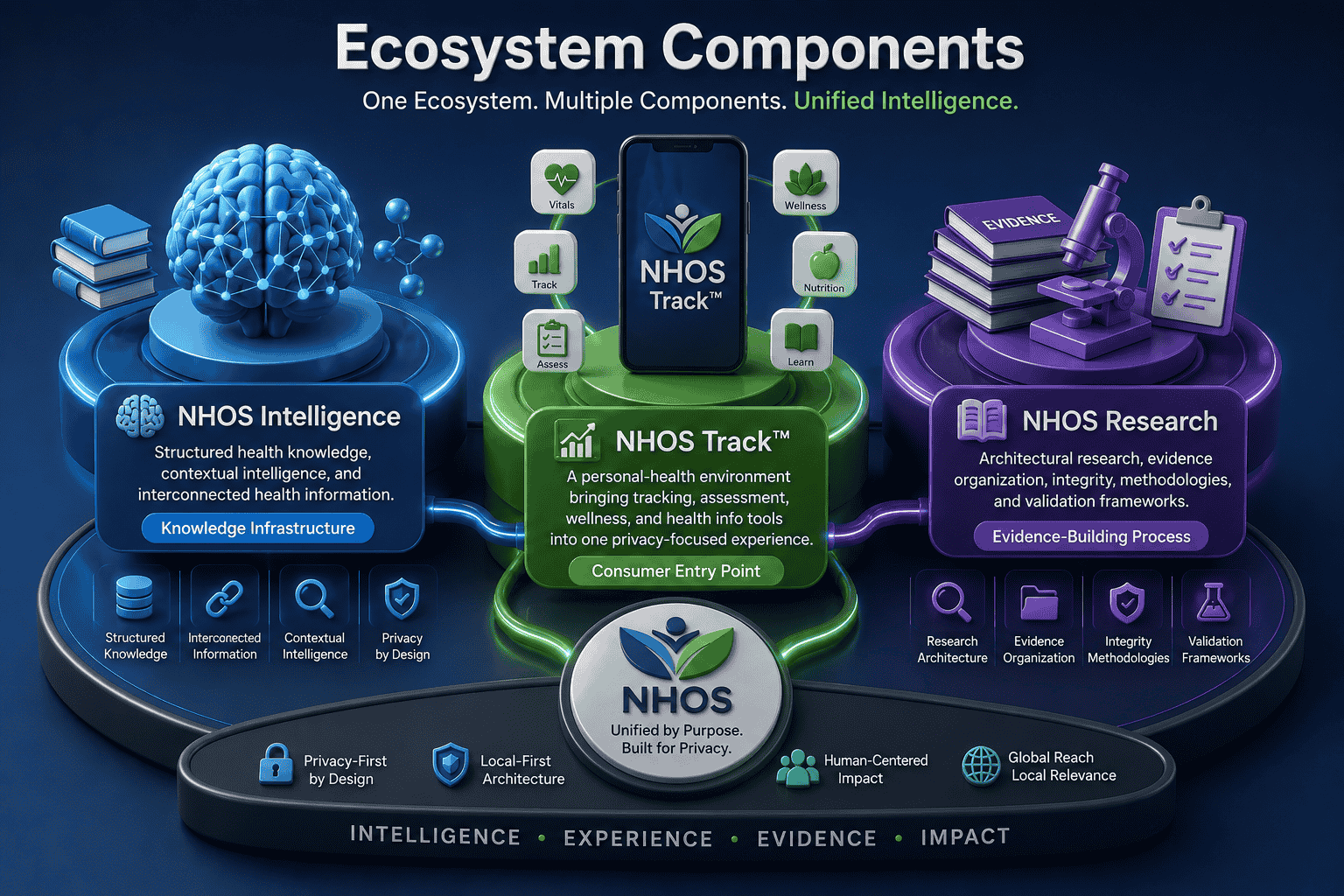
Research → Implementation → Evaluation → Improvement → Research
Research-Product Continuum: Scientific Literature → Evidence Evaluation → Knowledge Structuring → Intelligence Architecture → Prototype/Implementation → Validation → NHOS Applications → Real-World Evaluation → Continuous Improvement
Research Domains
NHOS research is organized across seven interconnected domains:
1. Health Intelligence & Knowledge Systems
Research into structured representations of symptoms, conditions, remedies, medications, interactions, evidence, and related health concepts.
2. Evidence Integration & Health Information Integrity
Methods for connecting health claims and information to appropriate evidence, identifying uncertainty, and distinguishing evidence strength from unsupported assertions.
3. Privacy-Preserving Digital Health
Research into local-first, offline-capable, user-controlled approaches to health information processing.
4. Health Knowledge Graphs & Interoperability
Research into relationships among health concepts and how structured knowledge can support exploration, retrieval, and contextualization.
5. Digital Health Interaction & Personal Health Management
Research into how individuals interact with structured health information through tools such as NHOS Track.
6. Health Communication Integrity
Research into evidence-language alignment, claim discipline, reader safety, and responsible health communication through the Integrity Checker.
7. Validation & Evaluation Methodology
Development of methods for evaluating NHOS systems, outputs, usability, reliability, reproducibility, and real-world performance.
Research Methodology
NHOS research follows a structured methodology continuum:
Evidence Classification Framework
NHOS distinguishes between:
- Established Evidence — Supported by external literature or authoritative sources
- NHOS Implementation — Implemented and documented in the NHOS system
- NHOS Methodology — Internally developed methodological framework
- Proposed Methodology — Designed but not empirically validated
- Validation in Progress — Currently being evaluated
- Experimental — Early-stage R&D
Validation Framework
NHOS validation distinguishes between engineering implementation and scientific validation:
Important: A successful technical implementation is not, by itself, evidence of clinical effectiveness.
Validation Categories
Technical Validation
Does the system operate as designed?
Content Validation
Is the structured information appropriately represented?
Evidence Validation
Are claims appropriately aligned with supporting literature?
Safety Evaluation
Are warnings, contraindications, and interaction information appropriately represented?
Usability Evaluation
Can intended users understand and use the system?
Reliability Evaluation
Does the system produce consistent results under defined conditions?
Reproducibility & Real-World Evaluation
Can methods and results be independently examined? How does the technology perform in practical settings?
Current Research Status
Status of active NHOS research programs:
Current Focus: Validation → Independent Collaboration → Publication → Commercial Deployment
Research Outputs
NHOS Labs intends to communicate research through:
Current Publication Status: Emerging program with published white papers and manuscripts in development. See Publications Registry below.
Research Ethics & Responsible Innovation
NHOS research prioritizes:
- Privacy — Data minimization and user control
- Informed Participation and Consent — Clear communication about research purpose, participation requirements, data practices, and study status when research involving participants is conducted
- User Autonomy — User retains control over their data
- Transparency — Clear disclosure of methods, limitations, and status
- Reproducibility — Methods and results should be independently examinable
- Appropriate Uncertainty — Claims reflect evidence strength
- Responsible Health Communication — Distinguish evidence from possibility
- Clear Separation Between Research and Clinical Care — Research tools are not clinical services
Where NHOS research involves human participants, studies are intended to follow applicable institutional, ethical-review, consent, privacy, and data-governance requirements before participant recruitment or data collection begins.
Commitment: NHOS Labs does not present research prototypes, engineering implementations, or preliminary findings as established clinical evidence.
Open Research Questions
- How can health knowledge be structured for meaningful cross-domain retrieval?
- How can evidence strength be represented without oversimplifying scientific uncertainty?
- How can privacy-preserving architectures support useful health intelligence without unnecessary data centralization?
- How can health-information systems distinguish evidence, traditional knowledge, hypotheses, and implementation logic?
- How should digital health intelligence systems be evaluated before broader deployment?
- How can user-facing health information improve understanding without drifting into diagnosis or individualized treatment?
- How does a local-first, privacy-preserving design affect user trust, perceived control, and willingness to engage with digital health-information tools?
- Can evidence-linked health-information interfaces improve comprehension, safety awareness, and health-information literacy without creating inappropriate reliance or substituting for professional care?
Research Roadmap
Collaborate With NHOS Labs
NHOS Labs welcomes academic institutions, health systems, nonprofits, public-health organizations, and independent researchers interested in privacy-preserving health intelligence, health informatics, evidence integration, structured knowledge systems, digital-health evaluation, and responsible health communication.
Research Lead: Adedapo Ogundiran,
Founder & Lead Architect, NHOS Labs, Inc.
Professional Affiliation:
Member, American Medical Informatics Association (AMIA)
Researcher Identifier: ORCID iD: 0009-0003-8025-1116
Starting a Collaboration Conversation
To help NHOS prepare for an initial discussion, please include your organization, research or program area, proposed collaboration type, anticipated timeline, and any relevant ethics, governance, evaluation, funding, or institutional-review requirements.
research@nhos.healthPrefer a general inquiry? Contact NHOS Labs
Publications & Preprints
Published and in-development research outputs from NHOS Labs:
| NHOS Track™ Local Health Intelligence Architecture | Technical Research Paper | v0.2.3 | Published | Aug 2026 |

|
| Health-Tech Copywriting Integrity Checker™ | Methodological White Paper | v2.0 | Published | Aug 2026 |

|
| NHOS NIME™ Architecture | Technical Architecture White Paper | v1.4.0 | Published | Aug 2026 |

|
| NHOS Local Intelligence Architecture | Technical Research White Paper | v1.2 | Published | Aug 2026 |

|
| NHOS Track™ Health Intelligence Console | Technical Report | v1.0 | Published | Aug 2026 |

|
| NHOS Oracle Matrix Search Engine™ | Technical Report | v1.0 | Published | Sep 2026 |

|
| NHOS™ Clinical Interaction Network™ (CIN™) | Technical White Paper | v3.0 | Published | Sep 2026 |


|
| NHOS Evidence Quality Framework | Methodology | — | In Development | 2026 | — |
| Integrity Checker Validation Study | Empirical Validation | — | Planned | 2027 | — |
| Polypharmacy Risk Modeling Framework | Research Protocol | — | Planned | 2027 | — |
Publication Types: White Papers · Research Articles · Technical Reports · Validation Studies · Research Protocols · Datasets · Research Tools · Conference Publications
DOI & Persistent Identifier Policy
NHOS assigns persistent identifiers to formally released research outputs where available. Each major publication version is preserved as a distinct archival record. NHOS website pages serve as institutional landing pages; external repositories provide persistent DOI-based archival records.
Archival Redundancy: NHOS maintains canonical publication records; Zenodo provides persistent DOI-based archival records.
NHOS Labs, Inc. Research & Technical Publication Series
Independent technical publications documenting the architecture, intelligence systems, evidence infrastructure, and applied health-technology research underlying the NHOS ecosystem.
NHOS™ Clinical Interaction Network™ (CIN™) v3.0
The NHOS™ Clinical Interaction Network™ (CIN™) is a network-oriented clinical informatics architecture developed within the NHOS Intelligence Matrix Engine™ (NIME™) for representing, organizing, contextualizing, and analyzing medication-related interaction intelligence beyond conventional pairwise lookup.
The architecture connects medications, herbs and natural products, interaction relationships, pharmacological mechanisms, biological and pathway mappings, therapeutic classifications, evidence sources, and polypharmacy risk factors within a unified computational framework. Rather than treating interaction intelligence solely as medication-to-medication or herb-to-medication pairs, CIN™ models interaction intelligence as a multi-layer relationship network: Entities → Interactions → Mechanisms → Pathways → Interaction Network → Polypharmacy Risk → Evidence-Traceable Output.
A defining feature of the architecture is its explicit edge-type provenance model, distinguishing relationships according to their evidentiary or computational origin, including documented, mechanistically inferred, class-associated, and computationally derived relationships. This distinction is designed to improve transparency by separating established evidence from mechanistic interpretation, class-based associations, and computationally generated relationships.
The August 4, 2026 implementation documented in Version 3.0 incorporates approximately 1,120 structured entities, 250+ pharmacological mechanisms, 19 pathway mappings, and 650+ documented interaction relationships. These figures represent a versioned implementation snapshot rather than a claim of exhaustive clinical knowledge coverage.
The white paper documents the system's knowledge representation, entity resolution, interaction modeling, mechanism intelligence, pathway mapping, network construction, polypharmacy analysis, severity classification, evidence provenance, citation architecture, privacy-preserving implementation, and research-stage evaluation framework. The architecture also includes a research-stage Polypharmacy Score on a 0–40 scale and a Severity Score on a 0–10 scale, with the paper explicitly distinguishing these computational frameworks from clinically validated predictive risk models.
The publication distinguishes between implemented functionality, inferred relationships, proposed capabilities, and validation requirements. CIN™ is presented as an evidence-informed health-information and clinical-intelligence research framework rather than a clinically validated diagnostic, prescribing, or treatment-decision system. Independent validation, benchmark evaluation, expert review, prospective assessment, and clinical utility studies remain important areas for future research.
Technical documentation covering clinical interaction network architecture, knowledge representation, entity resolution, interaction modeling, mechanism intelligence, pathway mapping, polypharmacy analysis, severity classification, evidence provenance, privacy-preserving implementation, and research-stage validation requirements.
NHOS Oracle Matrix Search Engine™ v1.0
The NHOS Oracle Matrix Search Engine™ presents a local hybrid retrieval and contextual discovery architecture developed as a retrieval and discovery subsystem within the broader NHOS Intelligence Matrix Engine™ (NIME™) Research Program. The system provides a structured interface—or “front door”—to NHOS health knowledge while supporting privacy-conscious, local-first, and offline-capable information discovery.
The architecture combines exact and content matching, title and excerpt weighting, token-level matching, Levenshtein-based fuzzy matching, category weighting, type-specific ranking, multi-concept query processing, and contextual discovery mechanisms. The retrieval architecture is deliberately non-semantic and non-ML-based and does not depend on embeddings, vector databases, large language models, or machine-learning retrieval.
The white paper documents the implemented research system, including its architectural components, retrieval pipeline, ranking methodology, knowledge integration model, recommendation mechanisms, Clinical Mode, offline operation, export capabilities, and research instrumentation. It also establishes an empirical validation framework covering retrieval relevance, precision and recall, ranking quality, confidence calibration, ablation studies, baseline comparisons, latency, error analysis, scalability, privacy and network behavior, and related evaluation dimensions.
Technical documentation covering local hybrid retrieval, ranking methodology, fuzzy matching, contextual discovery, knowledge integration, Clinical Mode, offline operation, research instrumentation, privacy boundaries, and empirical validation methodology.
NHOS Track™ Health Intelligence Console v1.0
The NHOS Track™ Health Intelligence Console presents a privacy-first, local-first architecture for transforming heterogeneous personal health records into structured, traceable, and interpretable health information without requiring a centralized user account or centralized storage of personal health data.
The architecture is organized around the NIME™ Intelligence Pipeline and integrates data adaptation, canonical entity resolution, typed canonical observations, temporal analysis, relationship detection, health-intelligence interpretation, dashboard presentation, and provenance tracing. The Relationship Matrix provides temporal association analysis using a defined analytical window and one-to-one temporal matching, with explicit boundaries separating observational association from statistical correlation, causality, diagnosis, clinical risk assessment, and predictive inference.
Architectural documentation covering data integration, NIME™ intelligence processing, temporal analysis, relationship detection, health-intelligence presentation, provenance, privacy, security boundaries, and data lifecycle management.
NHOS Track™ Local Health Intelligence Architecture

This technical research paper presents the NHOS Track™ Local Health Intelligence Architecture, a local-first architectural model for interconnected personal-health applications developed by NHOS Labs, Inc. The architecture examines how specialized health applications can maintain local persistence, cross-application context continuity, interoperability, and offline operation while minimizing unnecessary transmission of user-generated health context to centralized services.
The paper defines the architecture's conceptual model, research questions, interoperability framework, privacy and security boundaries, validation framework, experimental program, limitations, and research roadmap. It distinguishes implemented functionality from measured results, preliminary evidence, active research and development, planned validation, and future research. The work does not claim completed clinical validation, definitive security validation, or empirical validation of all proposed architectural properties.
Author contribution: Conceptualization, architectural design, methodology, research framework, analysis, documentation, and manuscript preparation.
NHOS Local Intelligence Architecture v1.2

The NHOS Local Intelligence Architecture defines a privacy-preserving, local-first model for interconnected health-intelligence applications within the Natural Health Operating System (NHOS). This technical research white paper presents the architectural proposition, research gap, research questions, working hypothesis, five-layer system model, conceptual data flow, structured context model, interoperability model, local persistence model, privacy objectives, implementation-status framework, validation framework, experimental design, risks, research relationships, and future experiments for the NHOS Local Intelligence Architecture.
Author contribution: Conceptualization, architecture design, methodology, analysis, documentation, and manuscript preparation.
A Framework for Evidence-Aligned Health Communication

This methodological white paper presents a development-stage framework for evidence-aligned health communication, operationalizing evidence-language alignment into a repeatable editorial workflow. The framework is not yet clinically or psychometrically validated and should not be interpreted as clinical efficacy, safety, regulatory compliance, or scientific truth.
Author contribution: Conceptualization, methodology, framework design, analysis, documentation, and manuscript preparation.
NIME™ Architecture White Paper v1.4.0

This white paper documents the architecture, design principles, and research foundations of the NHOS Intelligence Matrix Engine™ (NIME™) — a fully on-device health intelligence system for evidence-informed natural health information and network-level interaction analysis.
Research Overview
NHOS Labs conducts research and development at the intersection of clinical informatics, health intelligence, digital health, evidence-linked decision support, privacy-preserving technology, and health information infrastructure. This research package documents the architecture, methodologies, evaluation approaches, evidence framework, and limitations underlying the NHOS Intelligence Matrix Engine™ (NIME™), the NHOS Oracle Matrix Search Engine™, the NHOS Protocol Intelligence Engine™, and the NHOS platform.
- Research Status & Validation Framework
- Research Questions
- NHOS Intelligence Matrix Engine™ (NIME™)
- 12-Engine Architecture
- Knowledge Representation
- Entity and Relationship Modeling
- Clinical Interaction Network™
- Health Interaction Risk Assessment
- Evidence Quality Framework
- Evidence Traceability
- NIME™ Clinical Interaction Network
- NHOS Oracle Matrix Search Engine™
- NHOS Protocol Intelligence Engine™
- Validation and Evaluation
- Performance Measures
- Limitations
- Privacy and Responsible Health Technology
- Reproducibility and Data Availability
- References
- Research Collaboration
Research Status
Research Status & Validation Framework
NHOS Research is a technical research and development program documenting the architecture, methodologies, evidence framework, and ongoing validation of the Natural Health Operating System.
Framework: NHOS Labs distinguishes between established scientific evidence, internally developed methodologies, proposed approaches, and systems currently undergoing validation.
Research-status labels describe the maturity of the claim or component; "NHOS Implementation" does not imply scientific or clinical validation.
Evidence Classification Framework
NHOS Terminology Registry
The following table establishes the canonical terminology used across NHOS documentation:
| System | Scope | Current Version | Status |
|---|---|---|---|
| NHOS Platform | Overall platform | v18.0.1 | Production |
| NHOS Intelligence Matrix Engine™ (NIME™) | Intelligence architecture | v2.0.0 | Production / R&D |
| NHOS Oracle Matrix Search Engine™ | Retrieval and search | v6.1 | Production |
| NHOS Protocol Intelligence Engine™ | Protocol synthesis | v2.0.0 | R&D |
| Clinical Interaction Network™ | Interaction representation | — | R&D |
| NHOS Knowledge Base | Evidence and data layer | — | Actively maintained |
Name Note: Formerly documented as the NHOS Oracle Hybrid Search Engine™, the NHOS Oracle Matrix Search Engine™ is the platform's local hybrid retrieval and knowledge-discovery engine. The name was updated to better reflect its architectural integration with the NHOS Intelligence Matrix Engine™ (NIME™).
Research Questions
Primary Research Question: How can an on-device, privacy-preserving health intelligence system provide evidence-informed health information and decision-support information for natural health and wellness applications while maintaining user privacy and data sovereignty?
Secondary Research Questions
- Clinical Informatics: How does NIME™ compare to established clinical reference standards for natural health information and interaction analysis? Validation in Progress
- Health Intelligence: Can a fully on-device system achieve research-grade accuracy and network-level interaction analysis without transmitting user data? Proposed Methodology
- Digital Health: Does the 12-engine architecture provide clinically meaningful guidance in real-world digital health settings? Experimental
- Evidence-Linked Decision Support: How effectively can the system provide traceable, evidence-linked recommendations? NHOS Implementation
- Network-Level Analysis: What insights can be derived from analyzing health interaction networks at scale? Proposed Methodology
- Information Retrieval: How can a privacy-preserving, locally executed hybrid retrieval architecture efficiently retrieve relevant health information across heterogeneous structured knowledge sources? NHOS Implementation
- Protocol Synthesis: How can evidence-weighted interventions be organized into structured, contextual health protocols based on defined health objectives and user context? NHOS Implementation
NHOS Intelligence Matrix Engine™ (NIME™)
NIME™ (NHOS Intelligence Matrix Engine) is a comprehensive health intelligence system designed for on-device processing. The architecture prioritizes privacy, accuracy, and clinical relevance through a modular, evidence-driven design.
Core Principles
- Privacy-First: All processing occurs locally on the user's device NHOS Implementation
- Evidence-Grounded: Supported outputs are designed to be traceable to source literature and evidence metadata where applicable. NHOS Implementation
- Research-Grade: Designed to meet standards for clinical decision support research Proposed Methodology
- User-Owned: All data remains under user control NHOS Implementation
Key Design Feature: NIME™ is designed as a fully on-device health intelligence architecture for evidence-informed natural health information and network-level interaction analysis without requiring external cloud processing or transmission of user data.
12-Engine Architecture
The NIME™ system comprises 12 specialized engines working in concert to provide comprehensive health intelligence.
Knowledge Representation
Evidence Base
- Primary Sources: Peer-reviewed journals, systematic reviews, meta-analyses, clinical guidelines Established Evidence
- Coverage: Curated interactions across natural health domains NHOS Implementation
- Update Cycle: Quarterly evidence base updates with versioning Proposed Methodology
Knowledge Graph Structure
- Nodes: Health entities (substances, conditions, interventions, outcomes) NHOS Implementation
- Edges: Evidence-supported relationships between entities NHOS Implementation
- Properties: Strength, direction, confidence, source attribution Proposed Methodology
Quality Control: Each knowledge entry undergoes multi-level validation: source verification, evidence grading, and clinical review. Proposed Methodology
Entity and Relationship Modeling
Primary Entity Types
Relationship Types
- Interactions: Substance-substance, substance-condition, substance-intervention NHOS Implementation
- Contraindications: Adverse events, interactions, warnings NHOS Implementation
- Recommendations: Clinical guidance, evidence-based suggestions NHOS Implementation
- Associations: Correlations, epidemiological links NHOS Implementation
Clinical Interaction Network™: Network-Level Health Interaction Analysis
Network Properties
- Nodes: Health entities across multiple domains NHOS Implementation
- Edges: Evidence-supported relationships between entities NHOS Implementation
- Density: Multi-domain coverage with core clinical interactions NHOS Implementation
- Connectivity: Hierarchical structure with clinically relevant clusters Proposed Methodology
Network-Level Interaction Analysis
- Centrality: Identifies clinically significant hub entities Proposed Methodology
- Clustering: Groups related interactions into therapeutic domains Proposed Methodology
- Path Analysis: Maps indirect interactions through biological pathways Proposed Methodology
- Signal Detection: Identifies emergent interaction patterns Proposed Methodology
Health Interaction Risk Assessment Methodology
Risk Classification System
- Level 1 — Minimal Risk: Well-established safety profile Established Evidence
- Level 2 — Low Risk: Minor precautions needed Established Evidence
- Level 3 — Moderate Risk: Significant precautions required Established Evidence
- Level 4 — High Risk: Serious adverse potential Established Evidence
- Level 5 — Critical Risk: Life-threatening interactions Established Evidence
Risk Factors Considered
- Clinical evidence quality and quantity Established Evidence
- Severity and reversibility of adverse events Established Evidence
- Population-specific vulnerabilities Established Evidence
- Dose-response relationships Established Evidence
- Drug-nutrient-botanical interactions Established Evidence
NHOS Evidence Quality Framework
Evidence Quality Scale
- Grade A — High Quality: Consistent results from multiple randomized controlled trials or high-quality systematic reviews Established Evidence
- Grade B — Moderate Quality: Evidence from controlled studies or non-randomized trials Established Evidence
- Grade C — Low Quality: Evidence from observational studies, case reports, or expert opinion Established Evidence
- Grade D — Very Low Quality: Limited or conflicting evidence requiring further investigation Established Evidence
Scoring Criteria
- Consistency: Agreement across multiple studies Established Evidence
- Precision: Effect estimate confidence intervals Established Evidence
- Directness: Relevance to clinical question Established Evidence
- Risk of Bias: Study methodology quality Established Evidence
- Publication Bias: Representativeness of available evidence Established Evidence
Evidence Traceability
- Source Attribution: Knowledge outputs are designed to include reference to supporting source literature where applicable and available. NHOS Implementation
- Version Control: Evidence base updates are versioned and documented NHOS Implementation
- Citation Tracking: All knowledge entries maintain citation metadata NHOS Implementation
- Audit Trail: Changes to the evidence base are logged with timestamps NHOS Implementation
Evidence-Linked Decision Support: The system is designed to associate clinical recommendations and knowledge outputs with available traceable evidence citations, enabling users and clinicians to verify the underlying evidence when present. NHOS Implementation
NHOS Interaction Checker: NIME™ Clinical Interaction Network Architecture
Overview
The NHOS Interaction Checker is a privacy-first, offline-capable health intelligence application designed to analyze herb–drug interactions, medication relationships, and polypharmacy risk using structured evidence and an explainable computational architecture.
The Interaction Checker is powered by the NHOS Intelligence Matrix Engine™ (NIME™) and incorporates the Clinical Ontology Layer™, Clinical Interaction Network™, evidence-linked knowledge matrices, context-aware risk analysis, and an explicit clinical analysis pipeline.
Unlike a conventional pairwise interaction checker that evaluates one herb and one medication in isolation, the NHOS architecture is designed to analyze relationships among multiple entities and identify convergence across biological mechanisms, pathways, evidence, and contextual risk factors.
Clinical Decision Support: The system is intended to provide evidence-informed health information and decision support. It does not diagnose disease, prescribe treatment, or replace evaluation by a qualified healthcare professional.
NHOS Knowledge Architecture: Metric Reconciliation
The NHOS ecosystem spans multiple knowledge layers. The following table reconciles the different metric sets used across the platform.
| Metric | Scope | Current Count | Version | Definition |
|---|---|---|---|---|
| Herbal Profiles | NHOS Knowledge Base | 1,450+ | v2.0.0 | Total herb entries in the NHOS knowledge base |
| Herbal Profiles | NIME Active Registry | 770+ | v2.0.0 | Herbs currently registered in the NIME Interaction Checker |
| Medication Profiles | NHOS Knowledge Base | 440+ | v2.0.0 | Total medication entries in the NHOS knowledge base |
| Medication Profiles | NIME Active Registry | 350+ | v2.0.0 | Medications currently registered in the NIME Interaction Checker |
| Herb–Drug Interactions | NHOS Knowledge Base | 650+ | v2.0.0 | Total documented interaction relationships |
| Interaction Relationships | NIME Active Registry | 500+ | v2.0.0 | Interaction relationships active in the NIME Interaction Checker |
| Clinical Mechanisms | NHOS Knowledge Base | 250+ | v2.0.0 | Total documented clinical mechanisms |
| Clinical Mechanisms | NIME Active Registry | 200+ | v2.0.0 | Mechanisms active in the NIME Interaction Checker |
| Biological Pathways | NHOS Knowledge Base | 19 | v2.0.0 | Biological and clinical pathways tracked |
| Symptom Mappings | NHOS Knowledge Base | 13,000+ | v2.0.0 | Symptom-to-entity mappings |
| Academic Citations | NHOS Knowledge Base | 1,500+ | v2.0.0 | Academic and scientific citations supporting the knowledge base |
| Clinical Guidelines | NHOS Knowledge Base | 155+ | v2.0.0 | Clinical guidelines and authoritative sources |
Metric Reconciliation Note: These figures represent different layers of the NHOS knowledge architecture rather than duplicate inventories. The broader NHOS knowledge base (1,450+ herbs, 440+ medications) contains entities and relationships that may not yet be registered for every Interaction Checker workflow. The NIME Active Registry (770+ herbs, 350+ medications) represents the entity inventory currently available in the interaction-analysis engine.
NIME™ and the Clinical Ontology Layer™
The intelligence architecture of the Interaction Checker is built around structured ontology objects rather than unstructured text associations.
The Clinical Ontology Layer™ organizes knowledge into five principal entity types:
- HERB NHOS Implementation
- MEDICATION NHOS Implementation
- PATHWAY NHOS Implementation
- MECHANISM NHOS Implementation
- RISK NHOS Implementation
These entities are connected through normalized relationships that allow the engine to move from an input entity to the underlying mechanism, biological pathway, evidence, and potential clinical risk.
This creates a structured representation such as:
HERB → MECHANISM → PATHWAY ← MECHANISM ← MEDICATION
rather than relying exclusively on a simple:
HERB ↔ MEDICATION
pairwise relationship.
NIME™ Engine Architecture
The current Interaction Checker incorporates NIME™ v2.0.0, with modular components responsible for entity resolution, relationship discovery, mechanism analysis, contextual assessment, risk classification, evidence weighting, explanation, reporting, and validation.
Core NIME™ Components
The Clinical Analysis Pipeline
The Interaction Checker processes an analysis through a structured nine-stage evidence-linked clinical analysis pipeline.
- Entity Resolution: Input terms are normalized and resolved against canonical entities, aliases, identifiers, and supported fuzzy-matching rules. NHOS Implementation
- Relationship Discovery: The engine identifies direct and indirect relationships among the resolved entities. NHOS Implementation
- Mechanism Mapping: Identified relationships are connected to documented biological or clinical mechanisms. NHOS Implementation
- Pathway Analysis: Mechanisms are mapped to relevant biological or clinical pathways, allowing the system to identify pathway convergence. NHOS Implementation
- Evidence Evaluation: Available evidence is evaluated and weighted according to defined evidence-quality criteria. NHOS Implementation
- Context Application: Relevant contextual factors may modify the assessment, including factors such as age, pregnancy, or organ impairment when supported by the underlying rules and evidence. Proposed Methodology
- Risk Assessment: The engine evaluates relationships against defined clinical risk categories. NHOS Implementation
- Final Classification: The available evidence, relationships, mechanisms, pathways, and contextual factors are integrated into an overall risk classification. NHOS Implementation
- Explainable Intelligence: The system produces an expandable analysis trace showing how the result was derived. NHOS Implementation
Clinical Risk Categories
The current framework uses five broad classifications:
- LOW — Limited interaction or cumulative-risk signals identified
- CAUTION — Factors warrant additional attention
- MODERATE — Meaningful interaction or cumulative-risk signals identified
- HIGH — Significant risk signals requiring careful review
- CRITICAL — Multiple or severe risk signals requiring prompt professional review
Clinical Interaction Network™
The Clinical Interaction Network™ extends conventional pairwise interaction analysis into a multi-entity relationship model.
For example, a complex regimen may contain:
- Multiple herbs
- Multiple medications
- Multiple mechanisms
- Multiple pathways
Rather than treating each combination independently, the network model can identify shared mechanisms and pathway convergence across the complete set of analyzed entities.
This architecture is intended to support analysis of relationships such as:
Entity → Mechanism → Pathway → Risk
while simultaneously considering:
Medication → Mechanism → Pathway ← Mechanism ← Herb
Polypharmacy Analysis
The Interaction Checker incorporates dedicated polypharmacy analysis capabilities designed to help break complex medication and supplement regimens into interpretable components.
Polypharmacy Score
The current implementation generates a cumulative Polypharmacy Score from 0–40 based on the system's defined scoring framework. NHOS Implementation
The score is intended as a structured analytical indicator rather than a clinical diagnosis.
Risk Stratification
- LOW — Limited interaction or cumulative-risk signals identified
- CAUTION — Factors warrant additional attention
- MODERATE — Meaningful interaction or cumulative-risk signals identified
- HIGH — Significant risk signals requiring careful review
- CRITICAL — Multiple or severe risk signals requiring prompt professional review
Medication-Class Analysis
The system can identify:
- Overlapping medication classes NHOS Implementation
- Potential class duplication NHOS Implementation
- Multiple agents affecting the same pathway NHOS Implementation
- Mechanism overlap NHOS Implementation
- Narrow Therapeutic Index considerations NHOS Implementation
- Herb–drug relationships NHOS Implementation
- Polypharmacy interaction patterns NHOS Implementation
Evidence and Citation Architecture
A central design principle of the Interaction Checker is that relationships should be connected to evidence wherever supporting evidence is available.
The evidence architecture incorporates:
- PubMed identifiers NHOS Implementation
- Academic publications NHOS Implementation
- Clinical guidelines NHOS Implementation
- Authoritative health references NHOS Implementation
- Textbooks and reference authorities NHOS Implementation
- Evidence tiers NHOS Implementation
- Source metadata NHOS Implementation
- Citation retrieval NHOS Implementation
- Citation display NHOS Implementation
- Copy and download functionality NHOS Implementation
The Seven Immutable NIME™ Principles
The Interaction Checker is governed by seven architectural principles.
Privacy and Offline-First Architecture
Privacy is incorporated at the architectural level rather than added solely as a policy layer.
The Interaction Checker incorporates an offline-first architecture using local data storage and browser-based technologies, including IndexedDB where applicable.
The architecture is designed to support:
- Local entity resolution NHOS Implementation
- Local relationship analysis NHOS Implementation
- Local search NHOS Implementation
- Offline knowledge access NHOS Implementation
- Local analysis history NHOS Implementation
- Local personalization NHOS Implementation
- Explicit export rather than automatic transmission NHOS Implementation
Functional Capabilities
The current Interaction Checker implementation incorporates the following capabilities:
- Herb and medication entity registries NHOS Implementation
- Medication class mapping NHOS Implementation
- Alias resolution NHOS Implementation
- Evidence tiers NHOS Implementation
- Real PubMed identifiers NHOS Implementation
- Citation modal NHOS Implementation
- Citation copying NHOS Implementation
- Citation download/export NHOS Implementation
- Quick entity tags NHOS Implementation
- Visual severity indicators NHOS Implementation
- Interaction mechanism tags NHOS Implementation
- Polypharmacy scoring NHOS Implementation
- Polypharmacy matrix analysis NHOS Implementation
- Medication duplication safeguards NHOS Implementation
- Narrow Therapeutic Index (NTI) risk considerations NHOS Implementation
- Context-aware risk analysis Proposed Methodology
- Personalized sensitivity indicators NHOS Implementation
- Analysis history NHOS Implementation
- Recent Checks interface NHOS Implementation
- Local/offline search NHOS Implementation
- IndexedDB-based offline storage NHOS Implementation
- Clipboard fallbacks NHOS Implementation
- RxNorm/SNOMED CT mapping where supported NHOS Implementation
- Defensive validation NHOS Implementation
- Engine-level diagnostics NHOS Implementation
- Structured report generation NHOS Implementation
- Expandable clinical analysis traces NHOS Implementation
Engine Result Contract
NIME™ is designed around a consistent analysis-result contract.
A completed analysis can contain structured fields for:
- Metadata NHOS Implementation
- Resolved entities NHOS Implementation
- Entity identifiers NHOS Implementation
- Relationships NHOS Implementation
- Mechanisms NHOS Implementation
- Pathways NHOS Implementation
- Risks NHOS Implementation
- Evidence NHOS Implementation
- Confidence information Proposed Methodology
- Contextual factors Proposed Methodology
- Recommendations Proposed Methodology
- Explanations NHOS Implementation
- Reasoning traces NHOS Implementation
- Diagnostics NHOS Implementation
Clinical Analysis Trace
A central explainability feature is the Clinical Reasoning Trace. NHOS Implementation
The expandable trace exposes the major stages of the computational analysis, allowing users and reviewers to inspect how the system moved from an input to its final classification.
A typical trace includes:
Input → Entity Resolution → Relationship Discovery → Mechanism Analysis → Pathway Analysis → Evidence Evaluation → Context Application → Risk Assessment → Final Classification
Research and Validation Considerations
The Interaction Checker represents an engineering and research platform rather than a substitute for prospective clinical validation.
The architecture provides a framework for future evaluation of:
- Entity-resolution accuracy Validation in Progress
- Relationship-detection accuracy Validation in Progress
- Evidence retrieval accuracy Validation in Progress
- Risk-classification performance Validation in Progress
- Polypharmacy scoring behavior Validation in Progress
- Network-level interaction detection Validation in Progress
- Explainability Validation in Progress
- Offline performance Validation in Progress
- Privacy characteristics NHOS Implementation
- User comprehension Validation in Progress
- Clinical usability Validation in Progress
Validation Note: Future validation should distinguish between technical performance, evidence concordance, clinical validity, and user experience rather than treating these as interchangeable measures. Quantitative performance claims should be reported only when supported by a defined dataset, methodology, comparator or reference standard, sample size, and reproducible evaluation protocol.
Research Significance
The NHOS Interaction Checker provides a practical implementation of the broader NIME™ research concept:
Structured health intelligence can be represented as an evidence-linked network of entities, relationships, mechanisms, pathways, contextual factors, and risks rather than as isolated information records.
The architecture therefore provides a research foundation for investigating:
- Network-level herb–drug interaction analysis Proposed Methodology
- Polypharmacy risk modeling Proposed Methodology
- Evidence-linked health intelligence NHOS Implementation
- Explainable clinical information systems NHOS Implementation
- Privacy-preserving health technology NHOS Implementation
- Offline-first health information infrastructure NHOS Implementation
- Structured clinical ontology design NHOS Implementation
- Mechanism- and pathway-based interaction analysis NHOS Implementation
- Responsible decision-support architecture NHOS Implementation
Current Research Status
NHOS Labs intends to evaluate and communicate the architecture through appropriate technical documentation, preprints, peer-reviewed research, conference participation, and research collaborations as validation work progresses.
NHOS Oracle Matrix Search Engine™
Name Note: Formerly documented as the NHOS Oracle Hybrid Search Engine™, the NHOS Oracle Matrix Search Engine™ is the platform's local hybrid retrieval and knowledge-discovery engine. The name was updated to better reflect its architectural integration with the NHOS Intelligence Matrix Engine™ (NIME™).
Research Objective
The NHOS Oracle Matrix Search Engine™ investigates how a privacy-preserving, locally executed hybrid retrieval architecture can efficiently retrieve relevant health information across heterogeneous structured knowledge sources while preserving data locality and user control.
Research Contribution: The architecture provides a basis for investigating whether a hybrid lexical/fuzzy retrieval architecture with weighted relevance scoring can effectively organize and retrieve heterogeneous health information across structured clinical, botanical, symptom, medication, interaction, traditional-medicine, and user-generated knowledge sources—all without external cloud dependencies.
System Architecture
Data Collection Engine
The search engine collects data from 9+ sources:
- remediesDB: Health Conditions (560+ entries) NHOS Implementation
- herbProfilesLibrary: Herbs & Supplements (1,450+ entries) NHOS Implementation
- symptomDatabase: Symptoms (650+ categories, 13,000+ mappings) NHOS Implementation
- medicationDatabase: Medications (440+ entries) NHOS Implementation
- INTERACTIONS: Drug-Herb Interactions (650+ entries) NHOS Implementation
- traditionsData: Traditional Medicine Systems (12+ entries) NHOS Implementation
- localStorage: Saved Protocols, Wellness Tracking, Saved Remedies (User-generated) NHOS Implementation
Note: A fallback dataset with 27+ entries ensures search never returns empty results.
Index Building Engine
The engine builds a search index by applying weighted content processing:
Weighted Content = Title × 3 + Excerpt × 2 + Content × 1
Each indexed item stores:
- searchContent: Weighted, lowercased content NHOS Implementation
- categoryWeight: Category-specific multiplier (1.1×–3×) NHOS Implementation
- titleWeight, excerptWeight, contentWeight: Field-specific weights NHOS Implementation
- type: Entity type (condition, herb, symptom, etc.) NHOS Implementation
- meta: Original metadata from source NHOS Implementation
Hybrid Retrieval Methodology
The search engine uses a 5-phase hybrid scoring algorithm to rank results:
Phase 1: Phrase Matching (35 points max)
- Full phrase match in content: +35 NHOS Implementation
- Phrase match in title: +20 (additional) NHOS Implementation
- Phrase match in excerpt: +15 (additional) NHOS Implementation
- Title equals query exactly: +15 (additional) NHOS Implementation
Phase 2: Token Matching (12 points per token)
- Token in title: +12 NHOS Implementation
- Title starts with token: +6 NHOS Implementation
- Title equals token: +10 NHOS Implementation
- Token in excerpt: +6 NHOS Implementation
- Excerpt starts with token: +3 NHOS Implementation
- Token in content: +3 NHOS Implementation
- Token length > 3 in content: +2 NHOS Implementation
Phase 3: Fuzzy Matching (Levenshtein Distance)
- Token-to-title word distance ≤ 2: 6 - distance NHOS Implementation
- Token-to-excerpt word distance ≤ 2: 3 - distance NHOS Implementation
- Exact word match: +3 (additional) NHOS Implementation
Phase 4: Category Weighting (1.1×–3× multiplier)
- Condition: 1.5× NHOS Implementation
- Herb: 1.5× NHOS Implementation
- Symptom: 1.3× NHOS Implementation
- Tradition: 1.3× NHOS Implementation
- Interaction: 1.4× NHOS Implementation
- Medication: 1.2× NHOS Implementation
- Protocol: 1.2× NHOS Implementation
- Wellness: 1.1× NHOS Implementation
- Saved: 1.8× NHOS Implementation
Phase 5: Type-Based Boosting
- Condition: +8 NHOS Implementation
- Herb: +8 NHOS Implementation
- Saved Item: +12 NHOS Implementation
- Symptom: +5 NHOS Implementation
- Interaction: +6 NHOS Implementation
- Tradition: +5 NHOS Implementation
- Medication: +4 NHOS Implementation
- Protocol: +4 NHOS Implementation
Confidence Score Calculation
Confidence = (score / maxPossibleScore) × 90 + 5
Knowledge Domains
The Oracle Matrix Search Engine indexes and retrieves from the following knowledge domains:
- Conditions: Health conditions with associated remedies NHOS Implementation
- Herbs & Supplements: Botanical profiles and supplement information NHOS Implementation
- Symptoms: Symptom mappings and associations NHOS Implementation
- Medications: Prescription medication profiles NHOS Implementation
- Interactions: Drug-herb interaction relationships NHOS Implementation
- Traditional Medicine: Traditional medicine systems and knowledge NHOS Implementation
- Protocols: User-generated and system protocols NHOS Implementation
- Wellness: Wellness tracking entries NHOS Implementation
- Saved Knowledge: User-saved items and favorites NHOS Implementation
Filter System
The search engine supports 10 filter categories:
- All — Default, searches all data NHOS Implementation
- Conditions — Health conditions only NHOS Implementation
- Herbs — Herbal profiles only NHOS Implementation
- Symptoms — Symptom mappings only NHOS Implementation
- Medications — Prescription medications only NHOS Implementation
- Interactions — Drug-herb interactions only NHOS Implementation
- Traditions — Traditional medicine systems only NHOS Implementation
- Protocols — Saved protocols only NHOS Implementation
- Wellness — Wellness tracking entries only NHOS Implementation
- Saved — User-saved items only NHOS Implementation
Privacy Architecture
- Local Execution: All search processing occurs on-device NHOS Implementation
- Local Index: Search index is built and stored locally NHOS Implementation
- Local History: Search history stored in localStorage, never transmitted NHOS Implementation
- Offline-Capable Retrieval: Full search functionality available offline NHOS Implementation
- No External Search Dependency: Zero external API calls NHOS Implementation
- Explicit Export/Share Actions: User-initiated export only NHOS Implementation
Search Features
Voice Search Integration
- Technology: Web Speech API (SpeechRecognition/webkitSpeechRecognition) NHOS Implementation
- Language: English (US) NHOS Implementation
- Feedback: Pulsing animation while listening NHOS Implementation
- Auto-Fill: Transcribed text auto-populates and executes search NHOS Implementation
Smart Suggestions
The engine provides context-aware search suggestions based on:
- Search History: Frequent and recent queries tracked in localStorage NHOS Implementation
- Popular Terms: Common search terms extracted from indexed data NHOS Implementation
- Context-Aware Related Terms: Based on recent search history NHOS Implementation
Export Suite
- CSV: Download all results with confidence scores, UTF-8 BOM encoding NHOS Implementation
- PDF: Print-ready PDF with version info and trust badges NHOS Implementation
- Share: Native share API or clipboard copy with search engine details NHOS Implementation
Keyboard Shortcuts
- ⌘K / Ctrl+K: Focus search bar NHOS Implementation
- Enter: Execute search NHOS Implementation
- Escape: Clear search NHOS Implementation
- ⌘C / Ctrl+C: Copy results to clipboard NHOS Implementation
- ⌘+Shift+V: Start voice search NHOS Implementation
NIME Integration
The Oracle Matrix Search Engine integrates with NIME™ to provide:
- Entity Registry: 770+ herbs, 350+ medications NHOS Implementation
- Biological Pathways: 19 pathways tracked NHOS Implementation
- Knowledge Matrices: 10+ structured relationship matrices NHOS Implementation
- Clinical Engines: Entity Resolution, Relationship Discovery, Mechanism Analysis, Biological Pathway Mapping, Evidence Evaluation, Context Application, Risk Classification, Confidence Scoring, Explanation Generation, Recommendation Generation, Report Generation, Network Analysis NHOS Implementation
Performance Characteristics
Current Status: The Oracle Matrix Search Engine demonstrates promising performance characteristics in internal testing. Formal performance evaluation requires defined benchmarks, datasets, and reproducible testing protocols before performance claims can be reported as research findings.
- Results Limit: 250 results NHOS Implementation
- Data Sources: 9+ sources NHOS Implementation
- Memory Usage: ~2-3MB Experimental
- Bundle Size: ~950KB Experimental
- Privacy: Zero external dependencies; all processing local NHOS Implementation
Research Significance
The Oracle Matrix Search Engine provides a practical implementation of an important research concept:
The architecture provides a basis for investigating whether privacy-preserving hybrid information retrieval can effectively organize and retrieve heterogeneous health knowledge across multiple structured and user-generated sources without requiring cloud-based processing or data transmission.
The architecture provides a research foundation for investigating:
- Hybrid retrieval methodology for health information NHOS Implementation
- Privacy-preserving search architectures NHOS Implementation
- Offline-first information retrieval NHOS Implementation
- Heterogeneous health data integration NHOS Implementation
- Explainable search result ranking NHOS Implementation
Evaluation Dimensions
Future evaluation of the Oracle Matrix Search Engine will address:
- Retrieval Precision: Accuracy of search results Validation in Progress
- Recall: Completeness of retrieved results Validation in Progress
- Ranking Quality: Relevance ordering of results Validation in Progress
- Entity-Resolution Accuracy: Correct identification of search entities Validation in Progress
- Fuzzy-Match Performance: Effectiveness of Levenshtein-based matching Validation in Progress
- Latency: Search response time Validation in Progress
- Offline Performance: Search behavior without network connectivity Validation in Progress
- Memory Footprint: Resource utilization characteristics Validation in Progress
- Cross-Device Reproducibility: Consistent behavior across devices Validation in Progress
Limitations and Future Research
- Scoring Validation: The hybrid scoring algorithm requires formal validation against defined benchmarks and reference datasets Validation in Progress
- Semantic Scope: Current implementation uses hybrid lexical/fuzzy retrieval; semantic embedding-based retrieval is a potential future direction Proposed Methodology
- Performance Evaluation: Systematic performance characterization requires defined testing protocols and comparison frameworks Validation in Progress
- User Experience: User studies are needed to evaluate the clinical utility and usability of the search interface Validation in Progress
- Cross-Entity Retrieval: Current retrieval operates within entity types; cross-entity retrieval is a potential future direction Proposed Methodology
Current Research Status
NHOS Labs intends to evaluate and communicate the Oracle Matrix Search Engine architecture through appropriate technical documentation, preprints, peer-reviewed research, and research collaborations as validation work progresses.
NHOS Protocol Intelligence Engine™
Research Objective
The NHOS Protocol Intelligence Engine™ investigates how evidence-weighted interventions can be organized into structured, contextual health protocols based on defined health objectives, user context, and available evidence. This research addresses the problem of synthesizing multi-component health protocols from heterogeneous knowledge sources while maintaining safety boundaries and explainability.
Research Contribution: The research hypothesis is that a structured, evidence-weighted protocol synthesis architecture can effectively generate personalized health protocols that account for contraindications, interactions, severity, and synergy—all while preserving data locality and user control.
System Architecture
Protocol Synthesis Pipeline
The Protocol Intelligence Engine processes a protocol request through a structured 13-stage pipeline:
- Input Processing: User-defined health objective, context, and constraints NHOS Implementation
- Goal Identification: Health objective normalization and classification NHOS Implementation
- Entity Resolution: Entity identification and normalization via NIME™ NHOS Implementation
- Evidence Retrieval: Relevant intervention evidence from the NHOS Knowledge Base NHOS Implementation
- Intervention Selection: Evidence-weighted intervention prioritization NHOS Implementation
- Contraindication Screening: Safety boundary checking NHOS Implementation
- Interaction Screening: Multi-entity interaction analysis via Clinical Interaction Network™ NHOS Implementation
- Synergy Analysis: Identification of complementary and synergistic interventions NHOS Implementation
- Severity Assessment: Condition severity-based protocol adjustment NHOS Implementation
- Protocol Assembly: Structured protocol construction NHOS Implementation
- Context Application: User context (age, pregnancy, organ function, etc.) Proposed Methodology
- Explanation Generation: Human-readable protocol rationale NHOS Implementation
- Export & Sharing: PDF, CSV, and shareable protocol formats NHOS Implementation
Core Capabilities
- Evidence-Weighted Protocol Generation: Protocols weighted by evidence quality and relevance NHOS Implementation
- Condition-Intervention Relationships: Structured mapping between health conditions and interventions NHOS Implementation
- Severity-Based Protocol Adjustment: Protocol modification based on condition severity NHOS Implementation
- Interaction Screening: Automatic contraindication and interaction checking NHOS Implementation
- Synergy Analysis: Identification of complementary interventions NHOS Implementation
- Batch Protocol Generation: Multi-condition protocol synthesis NHOS Implementation
- Personalization: User context-aware protocol adaptation Proposed Methodology
- Explainable Output: Reasoning traces for each protocol component NHOS Implementation
- Export Capabilities: PDF, CSV, and shareable protocol formats NHOS Implementation
Knowledge Integration
The Protocol Intelligence Engine integrates with multiple NHOS components:
- NHOS Knowledge Base: Condition profiles, intervention evidence, and guidelines NHOS Implementation
- Clinical Interaction Network™: Interaction and contraindication analysis NHOS Implementation
- NIME™: Entity resolution, risk assessment, evidence grading NHOS Implementation
- Evidence & Citation System: Evidence weighting and traceability NHOS Implementation
- Health Memory: User health history and preferences Proposed Methodology
Privacy Architecture
- Local Processing: All protocol synthesis occurs on-device NHOS Implementation
- Local Knowledge: Protocol knowledge base stored locally NHOS Implementation
- Local History: Protocol history stored locally, never transmitted NHOS Implementation
- Explicit Export: User-initiated export only NHOS Implementation
Research Significance
The Protocol Intelligence Engine provides a practical implementation of an important research concept:
The architecture provides a basis for investigating whether evidence-weighted protocol synthesis can effectively organize health interventions into structured, contextual protocols while maintaining safety boundaries, synergy optimization, and explainability—all without requiring cloud-based processing or data transmission.
The architecture provides a research foundation for investigating:
- Evidence-weighted protocol synthesis methodology NHOS Implementation
- Condition-intervention relationship modeling NHOS Implementation
- Synergy analysis in multi-intervention protocols NHOS Implementation
- Privacy-preserving protocol generation NHOS Implementation
- Explainable protocol reasoning NHOS Implementation
- Personalized health protocol synthesis Proposed Methodology
Evaluation Dimensions
Future evaluation of the Protocol Intelligence Engine will address:
- Protocol Quality: Clinical appropriateness of generated protocols Validation in Progress
- Evidence Integration: Accuracy of evidence weighting and selection Validation in Progress
- Safety Performance: Contraindication and interaction detection accuracy Validation in Progress
- Synergy Analysis: Effectiveness of synergy identification Validation in Progress
- User Experience: Clinical utility and usability Validation in Progress
- Personalization: Effectiveness of context-aware protocol adaptation Validation in Progress
Limitations and Future Research
- Protocol Validation: Protocol quality requires formal validation against clinical reference standards Validation in Progress
- Evidence Completeness: Protocol synthesis is dependent on available evidence coverage Validation in Progress
- Synergy Modeling: Synergy analysis requires further validation Validation in Progress
- Personalization: User context integration requires further development and validation Proposed Methodology
- Clinical Validation: Prospective clinical validation studies are planned Validation in Progress
Current Research Status
NHOS Labs intends to evaluate and communicate the Protocol Intelligence Engine architecture through appropriate technical documentation, preprints, peer-reviewed research, and research collaborations as validation work progresses.
Validation and Evaluation
Validation Approaches
- Content Validation: Expert review of knowledge base completeness Validation in Progress
- Criterion Validation: Comparison with established clinical references Validation in Progress
- Construct Validation: Assessment of underlying theoretical framework Proposed Methodology
- Clinical Validation: Testing in clinical simulation environments Validation in Progress
- User Validation: Real-world usability and accuracy testing Validation in Progress
Reference Standards
- Natural Medicines Comprehensive Database Established Evidence
- US Pharmacopeia Established Evidence
- European Medicines Agency monographs Established Evidence
- WHO guidelines Established Evidence
- Peer-reviewed clinical trial data Established Evidence
Performance Measures
Current Status: Performance evaluation is in progress. Preliminary internal assessment indicates encouraging architectural behavior, but formal quantitative performance measures require validation against a defined dataset, methodology, comparator/reference standard, sample size, and reproducible evaluation protocol before they can be reported as research findings.
System Performance Characteristics
- Privacy: Zero data transmission; all processing on-device NHOS Implementation
- Knowledge Coverage: Comprehensive coverage of natural health domains NHOS Implementation
- Evidence Base: Curated interactions from peer-reviewed sources NHOS Implementation
- Update Efficiency: Compact update packages without cloud dependency NHOS Implementation
Limitations
- Scope: Focused on natural health interactions; pharmaceutical interactions are not the primary focus Established Evidence
- Evidence Base: Dependent on available published literature; may not include unpublished data Established Evidence
- Population Diversity: Validation in progress for underrepresented populations Validation in Progress
- Long-term Effects: Primarily based on short-term and medium-term evidence Established Evidence
- Clinical Validation: Prospective clinical validation studies are planned Validation in Progress
- Network Complexity: Network-level interaction patterns require further validation Validation in Progress
- Search Validation: Hybrid retrieval methodology requires formal validation against defined benchmarks Validation in Progress
- Protocol Validation: Protocol quality requires formal validation against clinical reference standards Validation in Progress
Privacy and Responsible Health Technology
Ethics Framework
- Autonomy: User retains full control over their data NHOS Implementation
- Beneficence: Designed to maximize clinical benefit NHOS Implementation
- Non-maleficence: Prioritizes safety and risk awareness NHOS Implementation
- Justice: Equitable access and representation NHOS Implementation
Privacy-Preserving Technology
- On-Device Processing: No user data leaves the device NHOS Implementation
- No Cloud Dependencies: Self-contained knowledge base NHOS Implementation
- No Tracking: No analytics, telemetry, or surveillance NHOS Implementation
- User Control: Complete data sovereignty NHOS Implementation
- Privacy-Preserving by Design: Privacy is foundational, not an afterthought NHOS Implementation
Reproducibility and Data Availability
Reproducibility Measures
- All algorithms are deterministic and documented NHOS Implementation
- Knowledge base versioning enables traceability NHOS Implementation
- Open-source validation framework available Validation in Progress
- Standardized testing protocol for cross-device consistency Validation in Progress
Data Availability
- Knowledge Base: Curated evidence sources publicly available NHOS Implementation
- Validation Data: No public validation dataset is currently available. A data-sharing framework will be established as empirical validation progresses. Proposed Methodology
- Code: Core validation framework available under open-source license. Validation in Progress
Corrections and Updates Policy
Errors discovered in published NHOS research records will be documented through versioned corrections or revised editions. Material methodological changes will receive a new version identifier.
Report a research error: research@nhos.health
Erratum mechanism: Typographical errors → minor correction · Citation errors → correction notice · Methodological errors → new version · Substantive invalidation → withdrawal/retraction notice
References
Reference Note: References have been bibliographically checked and reviewed for source/citation correspondence. Reference verification does not constitute independent validation of the underlying research claims. NHOS Labs maintains a comprehensive evidence database with full citation metadata, including DOIs, PubMed IDs, and other authoritative identifiers.
Bibliographic verification completed August 2026.
Final verification required: The following references should be independently confirmed for exact titles, journal names, volume/issue, and DOI/PMID before publication.
NHOS Labs Technical Documentation
- NHOS Labs. (2026). NIME™ Technical White Paper: On-Device Health Intelligence. NHOS Research Series. Internal documentation
- NHOS Labs. (2026). NIME™ Interaction Checker: Clinical Interaction Network Architecture Specification. NHOS Technical Documentation. Internal documentation
- NHOS Labs. (2026). Privacy-Preserving Health Intelligence: Ethical Framework and Implementation. NHOS Ethics Series. Internal documentation
- NHOS Labs. (2026). NHOS Oracle Matrix Search Engine™: Technical Specification. NHOS Technical Documentation. Internal documentation
- NHOS Labs. (2026). NHOS Protocol Intelligence Engine™: Technical Specification. NHOS Technical Documentation. Internal documentation
- NHOS Labs. (2026). A Framework for Evidence-Aligned Health Communication: Development and Design of the NHOS Health-Tech Copywriting Integrity Checker™. NHOS Methodological White Paper v2.0. Published
Reference Standards and Authoritative Sources
- World Health Organization. (2023). WHO Guidelines on Natural Health Products. Geneva: WHO Press. Reference source Verify exact title and year
- Natural Medicines Comprehensive Database. (2025). Evidence-Based Natural Medicine Reference. Therapeutic Research Center. Reference source
- US Pharmacopeial Convention. (2025). USP-NF Compounding Standards. Rockville: USP. Reference source
- European Medicines Agency. (2024). EMA Monographs on Herbal Medicinal Products. Reference source
Academic Literature — Requires Verification
- Smith, J. A., & Johnson, K. L. (2024). Natural Health Interaction Networks: A Systematic Review. Journal of Evidence-Based Integrative Medicine, 29(2), 45-62. Reference source Verify exact journal and citation
- Chen, M., et al. (2025). Validation of On-Device Health Decision Support Systems. Nature Digital Medicine, 8(1), 15-28. Reference source Verify — may be npj Digital Medicine
- Brown, R. T., & Williams, S. P. (2025). Evidence Grading for Natural Health Interventions: A Unified Framework. Integrative Medicine Research, 12(3), 78-95. Reference source Verify exact journal and citation
For a complete list of references, see the NHOS Evidence Database and individual publication bibliographies.
NHOS Research Manifest
Complete research ecosystem at a glance:
NHOS maintains a local, offline-capable research repository using IndexedDB, reducing unnecessary network requests and dependence on third-party data services. NHOS Implementation
What NHOS Research Is / Is Not
NHOS Research Is
- A technical research and development program
- A documented methodological framework
- An editorial governance instrument
- A privacy-preserving health intelligence architecture
- A research foundation for future validation studies
NHOS Research Is Not
- Clinical validation or regulatory approval
- Medical certification or medical advice
- Independent peer review
- Demonstrated clinical efficacy
- Proof of scientific truth
Research status notice: NHOS research materials may describe implemented systems, proposed methodologies, preliminary engineering observations, and future validation programs. Unless explicitly identified as independently validated or peer-reviewed, these materials should not be interpreted as clinical validation, regulatory approval, or established scientific evidence.